You lay off five employees to save $50,000 a month.
You want to offer something beyond their contractual severance, but cash is tight. So you consider letting them keep some of their unvested stock options.
The additional cash cost could be zero.
But that doesn't mean the equity decision is free.
It could reduce the shares available for future hires, create stock-compensation expense, or leave departing employees with options they cannot afford to exercise.
And for startups employing people in both the US and Israel, the same offer could create very different tax consequences.
In our hypothetical 20-person startup, choosing $50,000 in additional cash severance over a vesting-cliff waiver changes runway by only about five days.
What Canva Did Differently
On November 3, 2026, Canva announced a restructuring affecting 1,271 employees, or 22% of its workforce.
That figure did not represent 1,271 confirmed layoffs. Canva explicitly stated that some employees would face role changes or relocation, while others would leave.
For departing employees, Canva announced at least six months of salary, inclusive of statutory entitlements, along with additional benefits.
But one provision deserves more attention:
Canva removed the one-year equity vesting cliff for employees who had joined within the previous year.
Source: Canva's official announcement, November 3, 2026
Under a typical four-year vesting schedule with a one-year cliff, an employee who leaves after eleven months receives no vested options. An employee who stays twelve months normally receives the first 25%.
Canva did not publicly disclose the exact vesting formula or award terms used for its waiver.
But its decision raises a question for smaller startups:
When cash is tight, should you let departing employees keep equity they would otherwise lose?
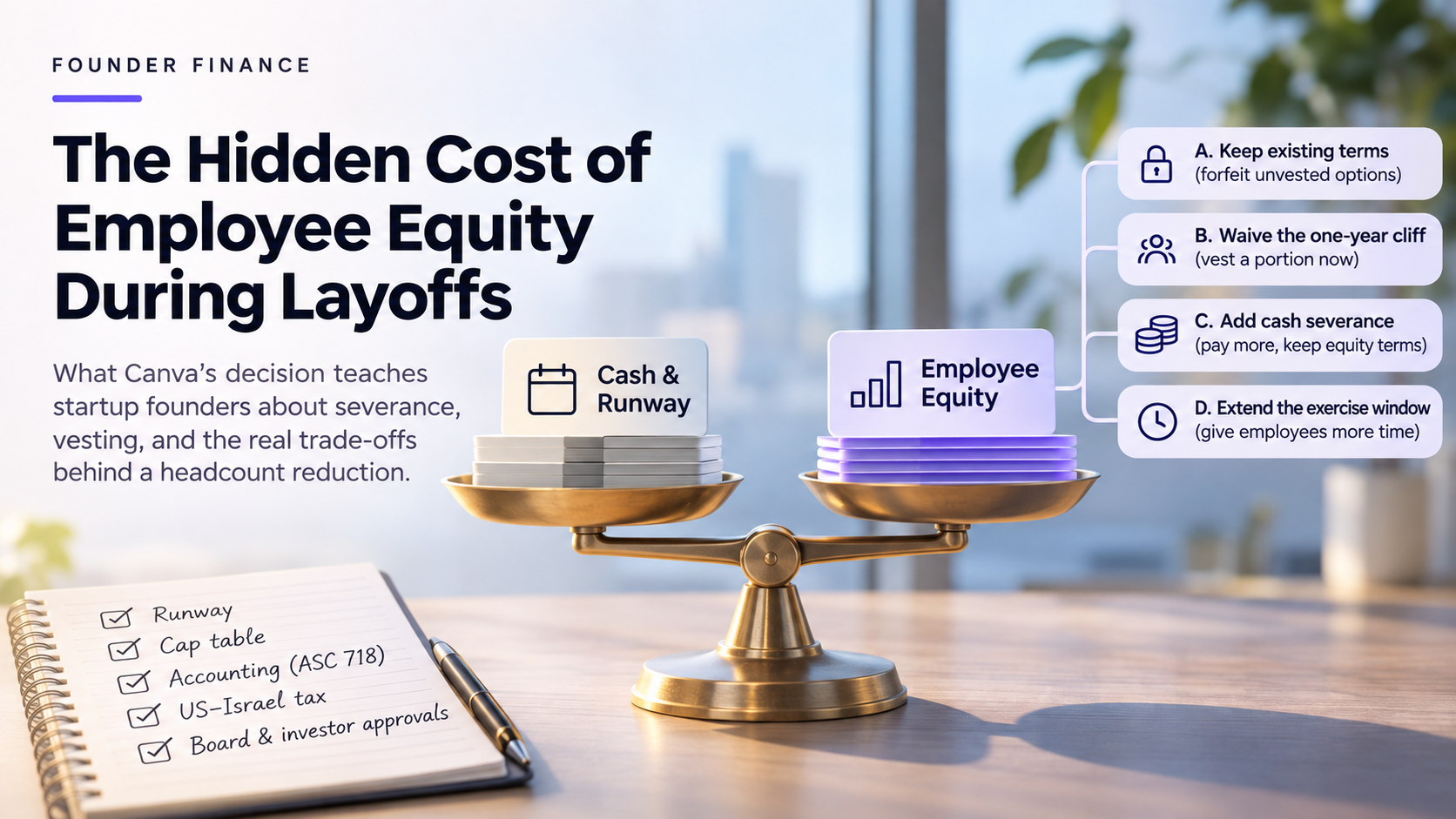
There are at least four ways to approach that decision. Each has a different financial consequence.
A 20-Person Startup Facing Its First Layoff
Consider a hypothetical seed-stage startup with:
- 20 employees, five of whom are departing.
- $3.5 million in cash and $350,000 in monthly net burn.
- Ten million fully diluted shares, including a one-million-share employee option pool.
- 600,000 options already granted, leaving 400,000 available.
- Four-year vesting schedules with one-year cliffs.
Three departing employees have been with the company for 24 months. Each received 50,000 options, with half already vested.
Two other employees joined more recently.
Employee A joined six months ago and received 40,000 options.
Employee B joined nine months ago and also received 40,000 options.
Neither has reached the cliff.
Together, the five employees hold 230,000 options, but only 75,000 are currently vested.
For simplicity, assume the options have a $1 exercise price, the current common-share fair market value is $1.50, and vested options normally expire 90 days after termination if not exercised.
These are hypothetical US employee grants, not Israeli Section 102 awards.
Policy A: Apply the Existing Vesting Terms
The two recent hires leave with no vested options.
Across all five employees, 155,000 unvested options are forfeited. Assuming the equity plan permits recycling, they return to the available option pool.
The company now has 555,000 options available for future grants.
There is no additional discretionary severance beyond existing legal and contractual obligations.
Policy B: Waive the One-Year Cliff
Suppose the company waives the cliff and credits the two recent hires for monthly service already completed.
Employee A receives 5,000 vested options: 40,000 × 6/48.
Employee B receives 7,500 vested options: 40,000 × 9/48.
Together, they retain 12,500 additional vested options.
The company's available option pool becomes 542,500 rather than 555,000.
The difference equals 0.125% of the original fully diluted capitalization.
But this does not necessarily create new dilution.
The options had already been granted, and the fully diluted share count already included both outstanding options and the unallocated reserve.
The company has simply allowed employees to retain awards that otherwise would have been forfeited.
The economic cost appears in the smaller reserve available for future employees, potential stock-compensation expense, and the possibility of needing to expand the option pool later.
Policy C: Pay Additional Cash Severance
Alternatively, the founder keeps the existing vesting terms but offers each of the five employees one additional month of base salary.
Assume monthly salary is $10,000 per employee.
The additional gross cash payment is $50,000, before incremental employer taxes and benefit costs.
The company preserves the same 555,000 available options as under Policy A.
It spends cash rather than preserving additional equity rights for departing employees.
Policy D: Extend the Exercise Window
This is the alternative many founders overlook.
Under the original agreements, employees have 90 days after termination to exercise vested options.
The company could consider extending that window to twelve months.
In our example, the three longer-serving employees collectively hold 75,000 vested options.
At a $1 exercise price, exercising all of them would require $75,000 in cash.
Giving those employees another nine months does not reduce their exercise price, but it gives them more time to arrange the money, assess the company's prospects, and decide whether to exercise.
The two recent hires still receive no vested options under Policy D alone. Extending the exercise window only helps employees who already have vested awards.
The company generally makes no additional direct severance payment, although modification, administrative, accounting, and potential tax costs remain.
There are important trade-offs.
Under US federal tax law, an incentive stock option generally loses favorable ISO treatment if exercised more than three months after ordinary employment termination, subject to exceptions. A later exercise may be taxed as a nonqualified option.
And under ASC 718, extending the exercise period can create incremental stock-compensation expense.
The company may also wait longer for unexercised options to expire and potentially return to the available pool.
Sources: IRS Publication 525 and Deloitte, ASC 718 modification accounting
Comparing the Four Policies
| Measure | Policy A: Existing vesting terms | Policy B: Waive the cliff | Policy C: Additional cash severance | Policy D: Extend the exercise window |
|---|---|---|---|---|
| Additional gross cash severance | $0 | $0 | $50,000 | $0 |
| Departing employees' vested options | 75,000 | 87,500 | 75,000 | 75,000 |
| Unvested options forfeited | 155,000 | 142,500 | 155,000 | 155,000 |
| Available options immediately after separation | 555,000 | 542,500 | 555,000 | 555,000 |
| Exercise window | 90 days | 90 days | 90 days | 12 months |
The table assumes forfeited options return to the pool and vested options remain outstanding immediately after termination. Later exercises or expirations can change the available reserve. All policies remain subject to baseline termination obligations.
Policies can also be combined, although doing so requires evaluating their combined cost.
Vested Options Are Not the Same as Severance
Under Policy B, the two recent hires collectively receive 12,500 additional vested options.
At the assumed $1 exercise price, buying those shares costs $12,500.
At a current common-share fair market value of $1.50, the aggregate intrinsic spread is $6,250.
But that is not a cash payment.
These are shares in a private startup. There may be no opportunity to sell them for years, and their eventual value could be substantially lower than today's estimated fair market value.
A departing employee must consider three questions:
- Can I afford to exercise?
- What taxes might exercising create?
- Am I comfortable holding illiquid shares that may ultimately be worthless?
Sometimes an additional $10,000 in cash will be far more useful than retaining options with uncertain future value.
Sometimes an employee who believes strongly in the company will prefer the options.
A founder should understand the difference rather than assuming more vested options automatically means a better severance package.
The US-Israel Difference Can Be Significant
For an Israeli-founded startup with employees in both countries, this decision deserves additional scrutiny.
Consider two employees who each have 10,000 vested options with a $1 exercise price and a current common-share fair market value of $3.
Both need $10,000 to exercise.
Their tax exposure can be very different.
United States
US employee with nonqualified stock options
Under the standard US federal treatment of an NSO without a readily determinable value at grant, the employee generally recognizes ordinary compensation income upon exercising vested options.
In this example:
10,000 × ($3 − $1) = $20,000 of compensation income.
The employee could need $10,000 to exercise, plus money to satisfy taxes on $20,000 of income, despite having no immediate way to sell the shares.
Different treatment applies to qualifying ISOs. ISO exercise generally does not create regular federal income tax at exercise, but it can generate an alternative minimum tax adjustment.
Israel
Israeli employee with qualifying Section 102 options
Israeli employees may receive options under Section 102 of the Israeli Income Tax Ordinance.
For qualifying trustee-held awards under the capital-gains track, exercising while the shares remain with the trustee generally does not itself create a taxable event.
Taxation generally occurs when shares are sold or released from the trustee.
The favorable capital-gains route normally requires the options or underlying shares to remain with the trustee for at least 24 months from grant. Qualifying gains are generally subject to a 25% capital-gains tax rate, although exceptions, additional taxes, and ordinary-income components may apply.
Unlike the US NSO employee, the Israeli employee may therefore be able to exercise without immediately recognizing taxable compensation.
But this favorable comparison depends on the award remaining qualified.
And this is where a well-intentioned cliff waiver becomes complicated.
In March 2025, the Israel Tax Authority published Position Paper 01/2025 addressing acceleration of employee equity awards.
The authority's stated position is that acceleration triggered by employment termination unrelated to an exit or IPO results in ordinary employment-income treatment for the accelerated awards, rather than the favorable Section 102 treatment that might otherwise apply.
This is the authority's published position, not a new statute. Its application depends on the precise award terms and circumstances.
Source: Israel Tax Authority Position Paper 01/2025
English explanation: EY, March 14, 2025
Legal analysis: Herzog Fox & Neeman
That does not mean every cliff waiver is automatically disqualified or that tax is immediately payable when vesting accelerates.
It means an Israeli tax specialist needs to determine whether the proposed modification changes the awards' tax treatment.
The founder might offer two employees the same additional vested options, only to discover that their tax consequences are materially different.
The Accounting Cost That Doesn't Appear in Your Cash Forecast
Under US GAAP, ASC 718 governs share-based payment accounting.
Accelerating vesting or extending the exercise period may be treated as an award modification requiring additional stock-compensation expense.
The treatment depends on the original vesting conditions, the modification date, whether the original awards were expected to vest, and the fair-value-based measurement of the awards.
For example, extending a post-termination exercise window can increase an option's fair value because the employee receives more time to exercise.
That incremental value may be recognized as compensation expense.
For awards that otherwise would not have vested, modifying the award to allow vesting can require recognition of modification-date compensation cost.
These are accounting costs, not necessarily cash payments.
A company should not use the $6,250 intrinsic spread from our earlier example as a substitute for an ASC 718 valuation.
The Bigger Question: Did the Layoff Actually Solve Your Runway Problem?
Return to our hypothetical startup.
It has $3.5 million in cash and burns $350,000 per month.
That's ten months of runway.
The five departing employees each receive $10,000 in monthly base salary, totaling $50,000.
For the runway model, assume the finance team projects $50,000 in monthly net cash savings, after accounting for eliminated employer costs and any transitional or replacement expenses.
That is a modeling assumption, not a claim that salary equals fully loaded employment cost.
The restructuring therefore reduces monthly net burn to $300,000.
Runway increases from 10 months to approximately 11.7 months before one-time restructuring payments.
Now compare the additional severance alternatives.
Under Policy B, assuming no incremental cash costs, runway remains approximately 11.7 months.
Under Policy C, the additional $50,000 cash payment reduces the balance to $3.45 million.
Runway becomes approximately 11.5 months.
Months of runway
The difference is about five days.
Five days of runway separate the $50,000 additional cash package from the equity cliff waiver in this simplified example.
That is the calculation I would want a founder to see before choosing between them.
If the company needs twelve months to complete product development, reach its next revenue milestone, and raise capital, neither option gets it there under these assumptions.
The company could spend days debating 12,500 options while overlooking a funding shortfall much larger than the severance decision itself.
Cash planning comes first. The equity decision follows.
What I Would Recommend to the Founder
Before offering accelerated vesting, additional cash, or an extended exercise window, I would work through four questions.
1. What is the actual cost of the restructuring?
Model weekly cash flows, not just monthly salary savings. Include employer taxes, accrued compensation, severance obligations, benefit continuation, legal costs, replacement contractors, and any retention payments.
2. What is each employee actually receiving?
Calculate vested options, exercise prices, realistic exercise deadlines, and potential tax exposure. Compare these with the immediate usefulness of cash.
3. What happens to the company's future hiring capacity?
Reconcile outstanding options, forfeited awards, vested options that may expire, and unallocated pool shares. Estimate future grants and any retention awards for remaining employees.
4. What must be approved before communicating the package?
Check the equity plan, grant agreements, board authority, investor consent rights where applicable, and the relevant accounting, tax, and employment-law requirements in each jurisdiction.
For US-Israel teams, involve the Israeli trustee and local tax and employment advisers before modifying Section 102 awards.
These decisions should be made as part of one restructuring plan, not separately by HR, finance, and legal.
The Real Lesson From Canva
Canva's decision shows that a severance package can include more than cash.
But for an early-stage company, the question isn't whether to copy Canva's approach.
It's whether management understands what each alternative costs the company, what it actually gives the employee, and what happens to the cap table and cash forecast afterward.
Waiving a cliff can preserve cash.
Extending an exercise window can give employees time.
Additional severance can provide immediate financial security.
None is automatically better.
And none should be approved without understanding the consequences.
The goal isn't to design the cheapest severance package. It's to make a responsible decision that treats employees fairly without jeopardizing the company's ability to survive.
For founders facing a restructuring, Andrew Financial helps model runway, option-pool capacity, and financial-reporting consequences, working alongside the company's legal and tax advisers.
Planning a restructuring?
Understand how employee equity, severance, and future hiring decisions affect your runway and cap table.
Talk to Andrew FinancialThis article is for general financial education and does not constitute individualized accounting, tax, or legal advice. Equity and termination outcomes depend on governing documents, applicable law, the employee's jurisdiction, and award-specific facts.